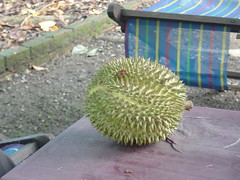
Perhaps one of the most notorious tropical fruits is the durian. Anthony Bourdain in his show Kitchen Confidential went to Vietnam to eat a live beating cobra heart. And a durian. Our guide says the Vietnamese saying about durians are that they "taste like heaven and smell like hell."
The smell is so awful that hotels have rules about guests bringing them to the room. The most common comparison is to dirty diapers.
Durians are actually available in the United States. The Korean run supermarket in my area sells them. Still, I was not leaving Vietnam without eating a durian.
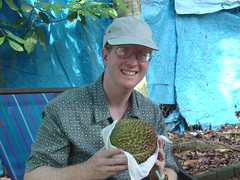
The durian is large with a tough spiky skin. The inside is divided into a series of of compartments each with its own pod. The pod contains a seed and the fruit surrounds the seeds. The fruit is sweet and mushy like over-ripe mango. Personally, I didn't find the taste or the smell as extreme in either direction as hyped. My son whose olafactory sense is probably keener than mine did find the smell a little repulsive.
The meat was very sticky and rather messy to eat. This durian was on the small side and it was still nearly a meal all to itself. I was a little underwhelmed with the experience, but perhaps I had built up the legendary durian just a little too much in my mind.
Friday, April 28, 2006

Snake Not On A Plane
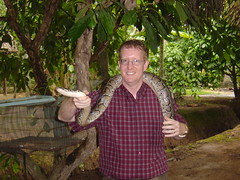
While at the honey farm, we had a little time to kill waiting for the rain to die down. They had this big snake in a cage that they let me and my son hold. I think it is some sort of python or other constrictor. My wife wouldn't have anything to do with it.
Eco-tourism is an industry the Mekong Delta area is really hoping catches on. I'm not sure roadside attraction level items like enormous snakes will be enough to keep people coming.
Eco-tourism is an industry the Mekong Delta area is really hoping catches on. I'm not sure roadside attraction level items like enormous snakes will be enough to keep people coming.
Thursday, March 16, 2006
Folk Singers and Tea
Our second stop on our Mekong River boat tour, after we got soaked by rain, was at a honey farm. The didn't actually show any honey production. Instead, the served very delicious honey tea and fresh fruit, which we enjoyed as we dried off.
While we ate and drank, two folk musicians came out and preformed some traditional love songs. The man played some sort of stringed guitar like instrument and the woman sang. We were expected to tip, and we did.
Because of the rain, and also since it was the off-tourist season, we were the only ones there. Another boat did arrive as we were leaving. That caused a minor trafic jam on the very small plank "dock" at the bee farm.
Powered by Castpost
While we ate and drank, two folk musicians came out and preformed some traditional love songs. The man played some sort of stringed guitar like instrument and the woman sang. We were expected to tip, and we did.
Because of the rain, and also since it was the off-tourist season, we were the only ones there. Another boat did arrive as we were leaving. That caused a minor trafic jam on the very small plank "dock" at the bee farm.
Powered by Castpost
Tuesday, March 07, 2006
Up The River
This video is taken from the boat ride up to a coconut candy place. The canal is fairly wide and has tall wood pedestrian bridges over it. The occasional houses along the river are the typical rural wood construction with corrugated metal roofs. The boat ride up to the candy plant took about five minutes and we saw very few houses or other structures. The plants along the bank came right down to the water's edge.
At the candy plant, they demonstrated the traditional method of melting the candy in a large metal kettle and then rolling it and slicing it on a table. The candy is very sweet and chewy, a little like taffy. It is wrapped in an edible cellophane wrapper, which confused my coworkers when I brought some into work after the trip. It was a much bigger hit at the nail salon my wife goes to.
The gift shop was a large thatched roof booth that had a lot of tourist items made out of coconut. We were expected to buy some candy and we did as well as a few souvenir chopsticks carved out of coconut tree. They were very ornately decorated and a good functional souvenir.
Powered by Castpost
At the candy plant, they demonstrated the traditional method of melting the candy in a large metal kettle and then rolling it and slicing it on a table. The candy is very sweet and chewy, a little like taffy. It is wrapped in an edible cellophane wrapper, which confused my coworkers when I brought some into work after the trip. It was a much bigger hit at the nail salon my wife goes to.
The gift shop was a large thatched roof booth that had a lot of tourist items made out of coconut. We were expected to buy some candy and we did as well as a few souvenir chopsticks carved out of coconut tree. They were very ornately decorated and a good functional souvenir.
Powered by Castpost
Tuesday, February 14, 2006
Small Boats and Smaller Boats
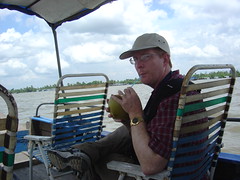
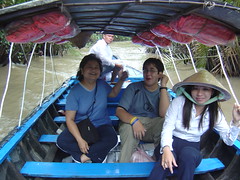
The tour boat we crossed the Mekong River on was maybe ten feet (3 meters) wide with moveable patio chairs for seating. We were greeted with coconut drinks as the picture shows. The boat was just a little bigger than one we had ridden on the Perfume River, but then the Mekong River is a bigger river. What it did not have was a small cabin in the back, which would be important later. Our crew consisted of the tour guide and the motor operator.
Our first stop was a ways up a small river tributary to a place where they made honey candy. The stop had working displays of the methods used to make this traditional snack. We bought several packs to give to friends and the Vietnamese nail techs my wife goes to.
On our way to the next stop, while out on the open waters of the main river, we got pounded by a large thunderstorm that sprung up out of nowhere. The flimsy vinyl awning that was the roof of the boat was no cover against the fierce cold driving rain of the storm. The boat driver steered to a mangrove patch on the bank of the river that provided some shelter against the rain, but we were soon soaked to the bone. Meanwhile our tour guide tried to raise the main office on her cellphone to get direction on what to do about the tour.
The rain soon let up enough for us to continue on our way. The next little river branch was too small for our “big boat”, so we transferred to another smaller boat with bench seats that drove us up the river to a fruit garden. This was the heart of darkness part of the trip. The river was very narrow with enormous tropical plants coming up right to the river edge. I imagined us being in Apocalypse Now going up river to find Colonel Kurtz. We ended up at a fruit garden where we could rest under shelter and dry of instead. A much more pleasant destination.
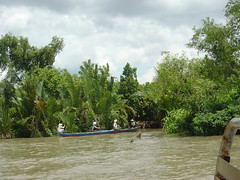
Elsewhere on the river we saw some boats no bigger than canoes painted in the same color as the other tour boats. I think the tour got cut short a little bit by the rain storm, but I imagine that these smaller boats are also used to take tourists up even smaller creeks. We were expected to tip the driver of both boats as well as the guide, so missing out on the last boat ride proboably saved us just a little money as well.
Our first stop was a ways up a small river tributary to a place where they made honey candy. The stop had working displays of the methods used to make this traditional snack. We bought several packs to give to friends and the Vietnamese nail techs my wife goes to.
On our way to the next stop, while out on the open waters of the main river, we got pounded by a large thunderstorm that sprung up out of nowhere. The flimsy vinyl awning that was the roof of the boat was no cover against the fierce cold driving rain of the storm. The boat driver steered to a mangrove patch on the bank of the river that provided some shelter against the rain, but we were soon soaked to the bone. Meanwhile our tour guide tried to raise the main office on her cellphone to get direction on what to do about the tour.
The rain soon let up enough for us to continue on our way. The next little river branch was too small for our “big boat”, so we transferred to another smaller boat with bench seats that drove us up the river to a fruit garden. This was the heart of darkness part of the trip. The river was very narrow with enormous tropical plants coming up right to the river edge. I imagined us being in Apocalypse Now going up river to find Colonel Kurtz. We ended up at a fruit garden where we could rest under shelter and dry of instead. A much more pleasant destination.
Elsewhere on the river we saw some boats no bigger than canoes painted in the same color as the other tour boats. I think the tour got cut short a little bit by the rain storm, but I imagine that these smaller boats are also used to take tourists up even smaller creeks. We were expected to tip the driver of both boats as well as the guide, so missing out on the last boat ride proboably saved us just a little money as well.
Monday, February 06, 2006
Across The River
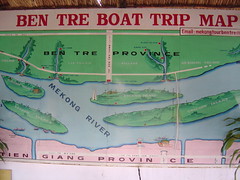
Between My Tho and Ben Tre, there are four islands in the middle of the Mekong River. The islands are named after the four sacred animals of Vietnam, the dragon, phoenix, unicorn, and turtle. The boat tour goes between the islands to get to the Ben Tre side of the river. The islands are heavily planted with small villages along the water’s edge.
On the phoenix island, Phung Island, there are the ruins of a complex built by an eccentric holyman named called the Coconut Monk because he subsisted solely on coconuts. The grotto was built in the 1960s and looks like an abandoned amusement park. Right on the edge of the water is a large steel Buck Rogers looking space ship.
The pass between the islands is very busy as all the river traffic goes through it. Large ferry boats are the primary way across the river. A very large modern concrete bridge is under construction that will connect My Tho to Ben Tre. When finished it will open up the Delta area to considerably more traffic from the Saigon area.
On the phoenix island, Phung Island, there are the ruins of a complex built by an eccentric holyman named called the Coconut Monk because he subsisted solely on coconuts. The grotto was built in the 1960s and looks like an abandoned amusement park. Right on the edge of the water is a large steel Buck Rogers looking space ship.
The pass between the islands is very busy as all the river traffic goes through it. Large ferry boats are the primary way across the river. A very large modern concrete bridge is under construction that will connect My Tho to Ben Tre. When finished it will open up the Delta area to considerably more traffic from the Saigon area.
Sunday, January 29, 2006
Swimming In The Mekong
The Mekong River is the economic heart of Vietnam. The river starts in the Himalayas and winds it way through all of south-east Asia before entering the South China Sea. Nine tributaries branch off the river and form the Mekong Delta. My Tho is the town on the river closest to Saigon.
Eco-tourism has become a huge component of the economy in the area. At least two enormous open-air restaurants cater to the tour bus industry. The multi-course meal here features as its center piece a locally farm raised fish that is grilled and served at the table “standing” upright.
Tour boats operate from the river front and take tourists to a variety of local native craft exhibits strung along the river. The river itself is a huge wide muddy super-highway with ferries, sand dredging barges, tour boats and fisherman all trying to run each other over. The boats come in all sizes and shapes. Most boats have some sort of stylized dragon on the bow to scare away the crocodiles that traditionally ply the river.
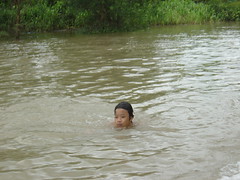
Much to our amazement, considering the ochre color of the water, small children swim and play right in the river. The level of biological contamination in this country with a still developing sanitary infrastructure would scare away most first world swimmers.
Still, children are children and there is nothing more refreshing than a dip into a dirty crocodile infested river to cool off on a hot day.
Eco-tourism has become a huge component of the economy in the area. At least two enormous open-air restaurants cater to the tour bus industry. The multi-course meal here features as its center piece a locally farm raised fish that is grilled and served at the table “standing” upright.
Tour boats operate from the river front and take tourists to a variety of local native craft exhibits strung along the river. The river itself is a huge wide muddy super-highway with ferries, sand dredging barges, tour boats and fisherman all trying to run each other over. The boats come in all sizes and shapes. Most boats have some sort of stylized dragon on the bow to scare away the crocodiles that traditionally ply the river.
Much to our amazement, considering the ochre color of the water, small children swim and play right in the river. The level of biological contamination in this country with a still developing sanitary infrastructure would scare away most first world swimmers.
Still, children are children and there is nothing more refreshing than a dip into a dirty crocodile infested river to cool off on a hot day.
Friday, January 20, 2006
Making Rice Paper
Not all the exhibits at the Cu Chi tunnels deal with the war. One display shows the traditional method of making rice paper. Rice paper is used as the wrapper for the Vietnamese version of the egg roll, called cha gio. The rice past is put on a small crepe pan style burner and then set on a bamboo screen to cool. This way the rice paper can stay fresh for several days without spoiling.
The exhibit also included a still making rice wine. Wine is a misnomer since it is at least 80 proof.
Across the way from this exhibit is a firing range where visitors can shoot AK-47's. It is the only legal firing range in Vietnam.
Powered by Castpost
The exhibit also included a still making rice wine. Wine is a misnomer since it is at least 80 proof.
Across the way from this exhibit is a firing range where visitors can shoot AK-47's. It is the only legal firing range in Vietnam.
Powered by Castpost
Tuesday, January 10, 2006
Visit The Cu Chi Gift Shop
One aspect of modern capitalist society that the Vietnamese Army has successfully emulated is the tourist attraction gift shop. As the Cu Chi tour ends, there is a long row of open air stalls selling souvenirs. The items for sale include all sorts of gear with the yellow star and red background, just in case you forgot who won the war. The tire tread sandals were tempting, although I’m sure they are no longer getting the tires from destroyed US trucks.
A large number of items appealed to the sense of machismo, like the cobra and scorpion liquor. Our guide mentioned to drink it while still in Vietnam if we wanted some because the chance of getting it through customs might be slim. They did offer free samples and it made Italian grappa and Kentucky moonshine taste smooth in comparison.
There was also a large (12 foot or longer) stuffed crocodile that you could pose with. You could get your picture either with or without the company of the very attractive lady in native garb at the booth. I kept getting a mental image of large groups of Japanese or Chinese businessmen on vacation trying to pass off the croc as something they killed while on safari.
I think the Communists may have won the war, but good old fashion marketing is winning the hearts and minds.
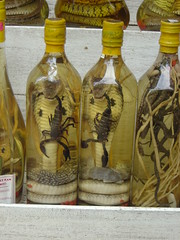
A large number of items appealed to the sense of machismo, like the cobra and scorpion liquor. Our guide mentioned to drink it while still in Vietnam if we wanted some because the chance of getting it through customs might be slim. They did offer free samples and it made Italian grappa and Kentucky moonshine taste smooth in comparison.
There was also a large (12 foot or longer) stuffed crocodile that you could pose with. You could get your picture either with or without the company of the very attractive lady in native garb at the booth. I kept getting a mental image of large groups of Japanese or Chinese businessmen on vacation trying to pass off the croc as something they killed while on safari.
I think the Communists may have won the war, but good old fashion marketing is winning the hearts and minds.
Tuesday, January 03, 2006
Into The Tunnels
The premiere attraction of the Cu Chi Tunnel area is of course to go into the tunnels. After touring all the dioramas and displays, visitors are given the opportunity to crawl through a 100 meter long segment of the actual tunnels. Ironically, these particular tunnels have been widened to accommodate the larger frames of western tourists, which was one of the virtues of the original small tunnels.
No one is obligated to go through the tunnels and my wife declined. My son and I were game. The particular stretch of tunnel used for tourists has exit points at the 10 meter and 25 meter marks for those that do get too claustrophobic. We made the whole distance. The tunnel is too tall to walk upright in leaving the options of either crawling on hands and knees or duckwalking through.
I crawled carrying my camcorder, giving me about 10 minutes of footage that consists of flashes from the Army guide up ahead taking our picture and the sounds of us huff and puffing our way through. The tunnel was very hot and just as humid as the outdoors, causing a lot of perspiration that turns the dry ground of the tunnel into mud when mixed. All in all, not an unpleasant experience, but not one I’m eager to repeat.
There is a convenient hand-washing station at the end of the tunnel for washing off the dust and mud.
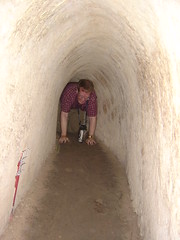
No one is obligated to go through the tunnels and my wife declined. My son and I were game. The particular stretch of tunnel used for tourists has exit points at the 10 meter and 25 meter marks for those that do get too claustrophobic. We made the whole distance. The tunnel is too tall to walk upright in leaving the options of either crawling on hands and knees or duckwalking through.
I crawled carrying my camcorder, giving me about 10 minutes of footage that consists of flashes from the Army guide up ahead taking our picture and the sounds of us huff and puffing our way through. The tunnel was very hot and just as humid as the outdoors, causing a lot of perspiration that turns the dry ground of the tunnel into mud when mixed. All in all, not an unpleasant experience, but not one I’m eager to repeat.
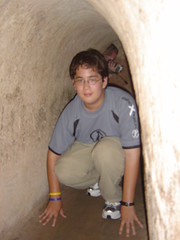
There is a convenient hand-washing station at the end of the tunnel for washing off the dust and mud.
Wednesday, December 21, 2005
Cu Chi Tunnels
The Cu Chi area just outside of Saigon was the center of Viet Cong activity during the war. As such, it was the subject of much military activity and the Viet Cong went to elaborate measures to hide from American soldiers.
One of the major methods was an elaborate tunnel complex that ran for literally hundreds of miles. In many cases, tunnels went up to and into American bases. Entrances into the tunnels were elaborately disguised and were so small that few American soldiers could enter them, even if they were found.
The Cu Chi tunnels are now a major tourist itnerary. Various parts of the Cu Chi area have been transformed into displays and exhibits about life for the Viet Cong soldiers and supporters. Tours are given by Army soldiers who demonstrate various parts of the tunnel system.
Before visiting the tunnels, a visitor center has a cut-away diorama of the complexity of the system, and tourists are shown a grainy vintage black and white movie praising the tanacity and dedication of the Viet Cong rebels. It was not subtle.
I was the only one of the Americans in our tour group willing to try to get into the tunnel. While I could just barely fit into the opening, when I crouched down, I got a minor panic attack. It took help from our guide to perform the rather gymnastic lift necessary to get out of the hole.
Other parts of the tour showed large craters from the constant aerial bombardment, different types and styles of pungee booby traps and pits, and all the various methods of concealing things like cooking smoke from detection.
There were also random pieces of destroyed military equipment on display and the opportunity to pose with cardboard cut-outs of black pajama clad insurgents. Please see my previous post here about my feelings about these types of displays.
Even accounting for differences in opinion over the war, it is hard to see the efforts of the Communist rebels and not be awed by their tenacity and ingenuity.
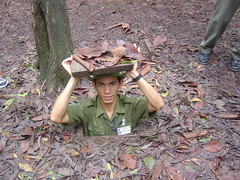
One of the major methods was an elaborate tunnel complex that ran for literally hundreds of miles. In many cases, tunnels went up to and into American bases. Entrances into the tunnels were elaborately disguised and were so small that few American soldiers could enter them, even if they were found.
The Cu Chi tunnels are now a major tourist itnerary. Various parts of the Cu Chi area have been transformed into displays and exhibits about life for the Viet Cong soldiers and supporters. Tours are given by Army soldiers who demonstrate various parts of the tunnel system.
Before visiting the tunnels, a visitor center has a cut-away diorama of the complexity of the system, and tourists are shown a grainy vintage black and white movie praising the tanacity and dedication of the Viet Cong rebels. It was not subtle.
I was the only one of the Americans in our tour group willing to try to get into the tunnel. While I could just barely fit into the opening, when I crouched down, I got a minor panic attack. It took help from our guide to perform the rather gymnastic lift necessary to get out of the hole.
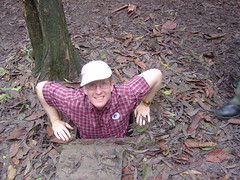
Other parts of the tour showed large craters from the constant aerial bombardment, different types and styles of pungee booby traps and pits, and all the various methods of concealing things like cooking smoke from detection.
There were also random pieces of destroyed military equipment on display and the opportunity to pose with cardboard cut-outs of black pajama clad insurgents. Please see my previous post here about my feelings about these types of displays.
Even accounting for differences in opinion over the war, it is hard to see the efforts of the Communist rebels and not be awed by their tenacity and ingenuity.
Monday, December 12, 2005
Room With A View
Our ninth floor room at the Grand Hotel in Saigon had great views of both the Saigon River and the city. In the first picture, the turret from the older part of the Grand Hotel (seen from the street in this picture) shows a series of low rise buildings near the waterfront. Immediately to the left as seen in this picture is the Rennaissance Saigon. Just to the right is another older hotel and another new high rise.
In a few years, I have to imagine that these older buildings will be demolished to make way for a new high rise that will probably block this great view of the river traffic up and down the Saigon River.
Across Dong Khoi street from the hotel there is a large construction site that is being billed as a multi-use high rise that was just starting. The construction noises woke us up pretty early one morning.
The pace of construction is Saigon is amazing and I fear a lot of the old character will be lost. While we were there a large department store opened further up Dong Khoi. Modeled after Japanese department stores, each floor specialized in a different area like women's clothes, electronics, and housewares. The top floor had a very nice food court and a huge gaming arcade that had videogames and bowling.
The prices were very high. Men's dress shirts were designer names and easily cost US$60 or more. Within walking distance on Dong Khoi, you can find tailor shops that will custom make clothes at a fraction of the cost. Times change.
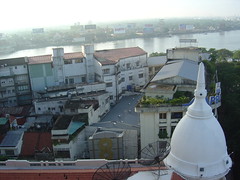
In a few years, I have to imagine that these older buildings will be demolished to make way for a new high rise that will probably block this great view of the river traffic up and down the Saigon River.
Across Dong Khoi street from the hotel there is a large construction site that is being billed as a multi-use high rise that was just starting. The construction noises woke us up pretty early one morning.
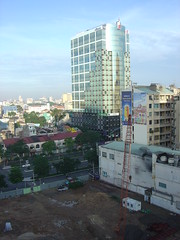
The pace of construction is Saigon is amazing and I fear a lot of the old character will be lost. While we were there a large department store opened further up Dong Khoi. Modeled after Japanese department stores, each floor specialized in a different area like women's clothes, electronics, and housewares. The top floor had a very nice food court and a huge gaming arcade that had videogames and bowling.
The prices were very high. Men's dress shirts were designer names and easily cost US$60 or more. Within walking distance on Dong Khoi, you can find tailor shops that will custom make clothes at a fraction of the cost. Times change.
Tuesday, December 06, 2005
The Grand Hotel In Saigon
Our headquarters while in Saigon was the Grand Hotel, which is a government-run colonial-era hotel on Dong Khoi near the Saigon river. The colonial portion of the hotel is three stories tall with large grand open rooms. A more modern addition is ten stories tall and has more standard sized hotel rooms.
Despite it's name, the Grand Hotel is not the grandest hotel in Saigon. The Caravelle is the premiere colonial era hotel in the area. Several international chains have built modern contemporary luxury high-rises in the area as well, including Sheraton, Sofitel, and Rennaissance. Rooms in these more luxurious hotels can be US$200 or more a night. Another large luxury hotel was about open while we were there in July.
The Grand Hotel had an excellent buffet breakfast with a great variety of fresh fruit and fruit juices each morning as well as the typical pho/omlette choice.
The location is also very nice being on the quieter end of Dong Khoi, which is the main shopping district for luxury goods. A wide variety of western and traditional restaurants were just blocks away.
The hotel itself had a very small lap pool with some token exercise machines in the corner of the outside pool patio serving as the "fitness center". A spa in the hotel offered a wide range of massages and manicures at prices competitive the salons all up and down Dong Khoi.
Overall, the hotel was very nice, but the general inexpensiveness of the hotels in the area would make us want to try one of the even more luxurious ones nearby if we visited again.
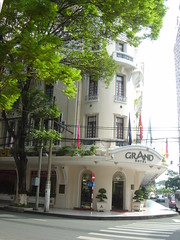
Despite it's name, the Grand Hotel is not the grandest hotel in Saigon. The Caravelle is the premiere colonial era hotel in the area. Several international chains have built modern contemporary luxury high-rises in the area as well, including Sheraton, Sofitel, and Rennaissance. Rooms in these more luxurious hotels can be US$200 or more a night. Another large luxury hotel was about open while we were there in July.
The Grand Hotel had an excellent buffet breakfast with a great variety of fresh fruit and fruit juices each morning as well as the typical pho/omlette choice.
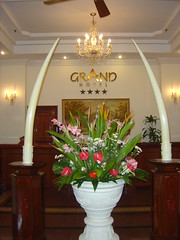
The location is also very nice being on the quieter end of Dong Khoi, which is the main shopping district for luxury goods. A wide variety of western and traditional restaurants were just blocks away.
The hotel itself had a very small lap pool with some token exercise machines in the corner of the outside pool patio serving as the "fitness center". A spa in the hotel offered a wide range of massages and manicures at prices competitive the salons all up and down Dong Khoi.
Overall, the hotel was very nice, but the general inexpensiveness of the hotels in the area would make us want to try one of the even more luxurious ones nearby if we visited again.
Tuesday, November 29, 2005
Khai Dinh in the Rain
The newest of the Nguyen Dynasty tombs is also the smallest. It also has the most prominant view. Located on the side of a hill, it is visible for miles around.
We arrived at the tomb during a rain shower and our guide rented us umbrellas right by the entrance. You have to love that capitalistic spirit in a socialist country. The temple is 130 steps up to the top and the rain makes the worn treads very slippery.
The temple is also the most "western" of the tombs with a lot of French influenced decoration. Khai Dinh was very taken with French style and many of the ornaments in the temple were imported from France. The tomb itself has a lif size statue of him sitting in a canopied chair.
We were inside the temple admiring the decor when the rain picked up dramatically and the power went out. The rain got so heavy that water was about to back up into the temple from the plaza outside. A worker went out and set a hose down to siphon off the rain to run down the steps instead.
After about a half hour, the rain had died down enough for us to risk the dash back down the steps to our van. The railings of the steps are elaborately carved dragons. The dragons can be seen in this post.
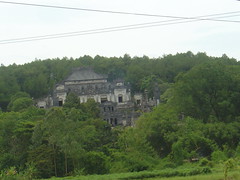
We arrived at the tomb during a rain shower and our guide rented us umbrellas right by the entrance. You have to love that capitalistic spirit in a socialist country. The temple is 130 steps up to the top and the rain makes the worn treads very slippery.
The temple is also the most "western" of the tombs with a lot of French influenced decoration. Khai Dinh was very taken with French style and many of the ornaments in the temple were imported from France. The tomb itself has a lif size statue of him sitting in a canopied chair.
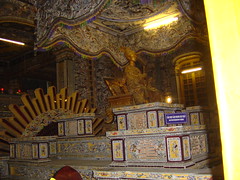
We were inside the temple admiring the decor when the rain picked up dramatically and the power went out. The rain got so heavy that water was about to back up into the temple from the plaza outside. A worker went out and set a hose down to siphon off the rain to run down the steps instead.
After about a half hour, the rain had died down enough for us to risk the dash back down the steps to our van. The railings of the steps are elaborately carved dragons. The dragons can be seen in this post.
Sunday, November 20, 2005
Tomb of Minh Mang
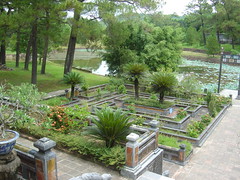
The second tomb that we visited in Hue was the tomb of Emperor Minh Mang. This tomb complex is considered one of the finest complexes of the Nguyen Dynasty tombs. The buildings are laid out along a central axis and are flanked by by two large man made lakes. A third lake separates the main buildings from the actual tomb area. As seen from above, the lakes form the rough outline of a body with the round tomb area where the head would be.
The overall effect of the buildings, gardens and lakes is a serene contemplative atmosphere. Walking trails surround the large lakes and the total length of nature trails is several miles.
The main set of buildings are symmetrical around a central axis with a formal feel. The garden at the end of buildings just before the Tan Nuyet Lake is set in the shape of the Chinese longevity symbol that is a major feature of all the tombs.
As we were leaving this tomb, we greeted a group of Australian tourists that we had seen at the restaurant the previous night. In fact all day, we kept coming across the same people that were on roughly the same itenerary as us. Vietnam is an increasing popular tourist destination for Australians.
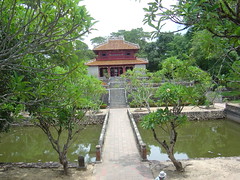
The overall effect of the buildings, gardens and lakes is a serene contemplative atmosphere. Walking trails surround the large lakes and the total length of nature trails is several miles.
The main set of buildings are symmetrical around a central axis with a formal feel. The garden at the end of buildings just before the Tan Nuyet Lake is set in the shape of the Chinese longevity symbol that is a major feature of all the tombs.
As we were leaving this tomb, we greeted a group of Australian tourists that we had seen at the restaurant the previous night. In fact all day, we kept coming across the same people that were on roughly the same itenerary as us. Vietnam is an increasing popular tourist destination for Australians.
Wednesday, November 16, 2005
Working Elephants
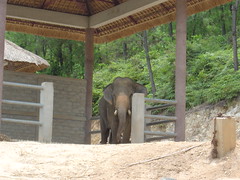
While traveling along a windy mountain road between tombs near Hue, we saw this elephant in his open air hut. Another elephant was in a hut right behind it. Down the hill in a much more ramshackle building were the owners of the elephants. They would let us take pictures but not get too close.
The elephants work in the forest pulling lumber. I think these elephants live better more comfortable lives than some of the local residents. I had always associated elephants with Thailand and India, completely unaware that they were in Vietnam as well.
The elephants work in the forest pulling lumber. I think these elephants live better more comfortable lives than some of the local residents. I had always associated elephants with Thailand and India, completely unaware that they were in Vietnam as well.
Wednesday, November 09, 2005
Roadside Incense
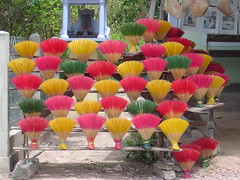
Just outside the gates of the very serene grounds of the Tu Duc Tomb complex near Hue was a row of tourist shops and small cafes catering to the tourists. Further down the road was this stand selling incense. The incense is beautifully arranged in these fan shaped arrangements. The colors were so pretty, we made the van turn around just so I could take some pictures.
Roadside stands in Vietnam tend to come in clusters. There is a Nobel prize winning theory behind this phenomena, but Vietnamese merchants have figured this out on their own. We would pass a pineapple stand to then pass about ten more in the next mile. A little further up the road would be a dozen stands in a row selling rice wine, then a group of stands selling something else.
There were a couple of other stands right near this one selling incense sticks as well, but this one had the prettiest arrangement. The incense was for pilgrims to the temples in the area. As we learned in Hanoi, all the major religious attractions are also working temples.
Roadside stands in Vietnam tend to come in clusters. There is a Nobel prize winning theory behind this phenomena, but Vietnamese merchants have figured this out on their own. We would pass a pineapple stand to then pass about ten more in the next mile. A little further up the road would be a dozen stands in a row selling rice wine, then a group of stands selling something else.
There were a couple of other stands right near this one selling incense sticks as well, but this one had the prettiest arrangement. The incense was for pilgrims to the temples in the area. As we learned in Hanoi, all the major religious attractions are also working temples.
Tuesday, November 01, 2005
Tu Duc Mausoleum
Scattered around the countryside around Hue are the tombs and mausoleums of the Nguyen Dynast rulers. Tomb is too light a word to use for these palatial monuments.
Each of these sites is really a summer palace complex that was built for each emperor. Construction would begin as soon as the emperor took the throne and would serve as a retreat from the Imperial City. Each one is different, reflecting the personality and ambition of it's emperor.
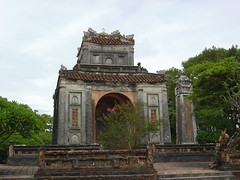
The first one we visited was the estate of the Emperor Tu Duc. The estate circles a beautiful lake and has several recreational pavillions surrounding the lake. Tu Duc considered himself a poet and he would sit in the pavillion overlooking the lake while he composed.
The Hoa Khiem Temple shown in the picture doubled as a working palace during his life and included a royal opera theater and lodging for his many concubines. After the the death of an emperor, his many concubines would often stay on as caretakers for the estate.
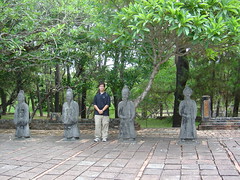
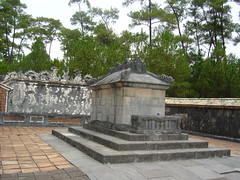
The actual sarcophogous is within a courtyard up a small hill. The courtyard outside the tomb includes rows of statues of horses, warriors and mandarins. These life size statues are to guard the tomb area.
There was a slave revolt during construction and the design was changed to reflect a new-found humility and modesty on the part of Tu Duc. He still had time for 50 course meals and dozens of concubines.
Unlike western tombs, the Tu Duc Mausoleum is open air and exposed to the elements. Our guide told us that the actual bodies of the emperors were buried in secret locations to avoid grave robbers.
The lake and gardens including a beautiful wooded area were magnificent but very hot. We went through two bottles of water each on the brief hour tour we took of the grounds. Fortunately there were several concession stands set up just for that need.
Each of these sites is really a summer palace complex that was built for each emperor. Construction would begin as soon as the emperor took the throne and would serve as a retreat from the Imperial City. Each one is different, reflecting the personality and ambition of it's emperor.
The first one we visited was the estate of the Emperor Tu Duc. The estate circles a beautiful lake and has several recreational pavillions surrounding the lake. Tu Duc considered himself a poet and he would sit in the pavillion overlooking the lake while he composed.
The Hoa Khiem Temple shown in the picture doubled as a working palace during his life and included a royal opera theater and lodging for his many concubines. After the the death of an emperor, his many concubines would often stay on as caretakers for the estate.
The actual sarcophogous is within a courtyard up a small hill. The courtyard outside the tomb includes rows of statues of horses, warriors and mandarins. These life size statues are to guard the tomb area.
There was a slave revolt during construction and the design was changed to reflect a new-found humility and modesty on the part of Tu Duc. He still had time for 50 course meals and dozens of concubines.
Unlike western tombs, the Tu Duc Mausoleum is open air and exposed to the elements. Our guide told us that the actual bodies of the emperors were buried in secret locations to avoid grave robbers.
The lake and gardens including a beautiful wooded area were magnificent but very hot. We went through two bottles of water each on the brief hour tour we took of the grounds. Fortunately there were several concession stands set up just for that need.
Tuesday, October 25, 2005
Captive Market
One trend we didn't quite expect on our trip to Vietnam was the tendancy for tour guides to bring out the gift selection in the middle of the trip. I think that because the tours themselves are so inexpensive, the boat operators rely on the supplemental sales of drinks and merchandise to make a profit. Several times when we wanted to buy drinks at the various stops, our guide suggested we wait until we get back on the boat. They always had a good selection of canned and bottled beverages on board, so it wasn't a problem giving them our business.
Inevitably, there was also some other type of merchandise available as well. We first encountered this on our boat ride in Halong Bay when as we were returning to port, the hostess on the boat brought out a large assortment of pearl jewelry. We ended up buying several items as gifts.
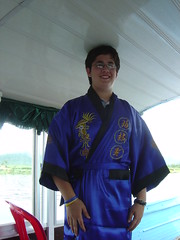
On the Perfume River, during our boat ride from Hue, we were presented with all varities of silk robes and and locally manufactured name brand clothing The prices were very reasonable and we did end up getting a few items. My son is modeling the reversible silk robe that he selected.
In the Mekong Delta and around Saigon, the tour operators expected tips instead. Overall, I prefer the clothing and jewelry as tour operator revenue enhancement. At least the purchases qualify as souvenirs.
Inevitably, there was also some other type of merchandise available as well. We first encountered this on our boat ride in Halong Bay when as we were returning to port, the hostess on the boat brought out a large assortment of pearl jewelry. We ended up buying several items as gifts.
On the Perfume River, during our boat ride from Hue, we were presented with all varities of silk robes and and locally manufactured name brand clothing The prices were very reasonable and we did end up getting a few items. My son is modeling the reversible silk robe that he selected.
In the Mekong Delta and around Saigon, the tour operators expected tips instead. Overall, I prefer the clothing and jewelry as tour operator revenue enhancement. At least the purchases qualify as souvenirs.
Wednesday, October 19, 2005
Begging By Boat
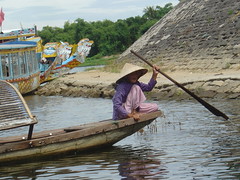
As would be expected in a developing nation like Vietnam, beggars would be found everywhere tourists would be. This very old lady had a small, small boat that she had rowed up to the dock at the Thien Mu Pagoda in Hue. From here she could solicit all the tourists arriving on the brightly colored dragon boats like the one in the background.
Beggars in Vietnam seemed more genuinely destitute than the equivalent homeless street person in the United States. They tended to be very old or suffered from some sort of severe disfigurement. They were also more persistent than American panhandlers.
Overall, the number of beggars we encountered was smaller than we had anticipated, but that didn't make their presence any less heart wrenching or pity inducing.
Beggars in Vietnam seemed more genuinely destitute than the equivalent homeless street person in the United States. They tended to be very old or suffered from some sort of severe disfigurement. They were also more persistent than American panhandlers.
Overall, the number of beggars we encountered was smaller than we had anticipated, but that didn't make their presence any less heart wrenching or pity inducing.
Subscribe to:
Posts (Atom)